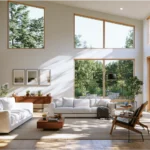
Key Takeaway
Black windows are not going out of style. A 2026 industry survey found 71% of experts named black a leading frame color, and manufacturers now offer engineered dark finishes on vinyl that resist fading and heat stress far better than early products did. Black framed windows deliver strong curb appeal and design flexibility, but performance depends on finish quality, glass package ratings, and sun exposure, not the color itself.
Black windows are not going out of style. Over the past 15 years or so, they have moved from a passing trend into an established, long-term option, and the manufacturers who build them have gotten much better at engineering dark frames that hold up. But black is still not automatically right for every home. Black frames ask more of the product, the finish, and the installer than white window frames do.
If you’re weighing black framed windows for a replacement project and quietly worried you’ll regret the choice in five years, this is written for you. We’ll cover the pros and cons of black windows, whether the trend is here to stay, how heat absorption and fading actually work (the part most articles get wrong), and how to judge a specific product instead of a color. The look itself has deep roots, going back to 19th-century steel casements, so this architectural style isn’t going anywhere.
Are Black Windows Going Out of Style?
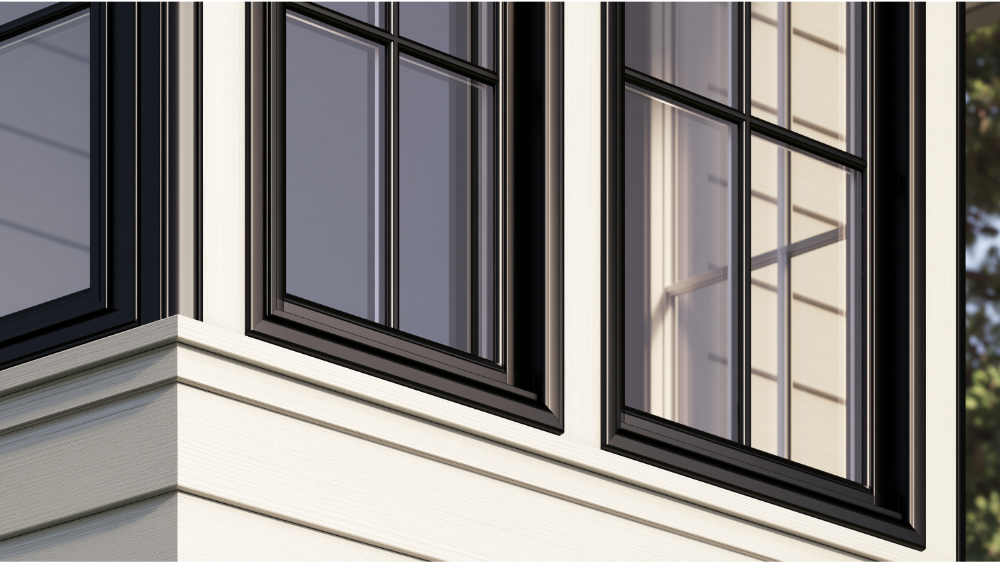
No. Black is an established frame color, but it isn’t the universal default, and the data pulls in two directions depending on who you ask.
A 2026 window industry survey found that 71% of participating experts named black a leading window frame color, ahead of white at 54%. A 2025 consumer study of 1,108 respondents told a different story: 45% said they’d choose white windows, while 14% picked black. Meanwhile, the Fenestration and Glazing Industry Alliance reported in 2026 that black vinyl windows have been produced for more than two decades, became a recognizable trend roughly 15 years ago, and have since moved toward staple status.
Put those together and you get a fair verdict. Black windows are a permanent option, widely available and well supported by manufacturers, while white still holds the broader market. Design trends in exterior color come and go, and this one has already outlasted the usual cycle, which is why we no longer treat it as just another trend. One distinction matters more than any survey: black is a color result, not a single product or manufacturing method. Two black windows can be built completely differently and perform completely differently.
Black Frames and Bold Contrast: Why the Look Took Hold
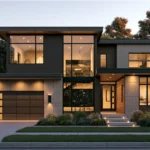
Part of it is the bold contrast. Dark frames set against light stucco or siding give a crisp outline that reads as intentional exterior design, without adding decorative trim to get there. That same dramatic contrast is why black windows anchor a façade so well in photographs and in person, and why they draw attention to architectural details that used to disappear.
Part of it is the view. Black frames recede visually, so your eye lands on the trees and the yard instead of the window itself. That fits the way people have been designing for indoor-outdoor living, clean lines, and open, minimalist designs with large glass.
And part of it is simple availability. Black used to mean steel or aluminum. Engineered dark finishes on vinyl changed that, which brought the look into a price and performance range far more homeowners can actually use. Modern black windows now show up on remodels, tract homes, and custom builds alike, and modern farmhouse designs did as much as anything to carry black window frames into everyday Northern California neighborhoods.
The Pros of Black Windows: Curb Appeal, Contrast, and Design Flexibility
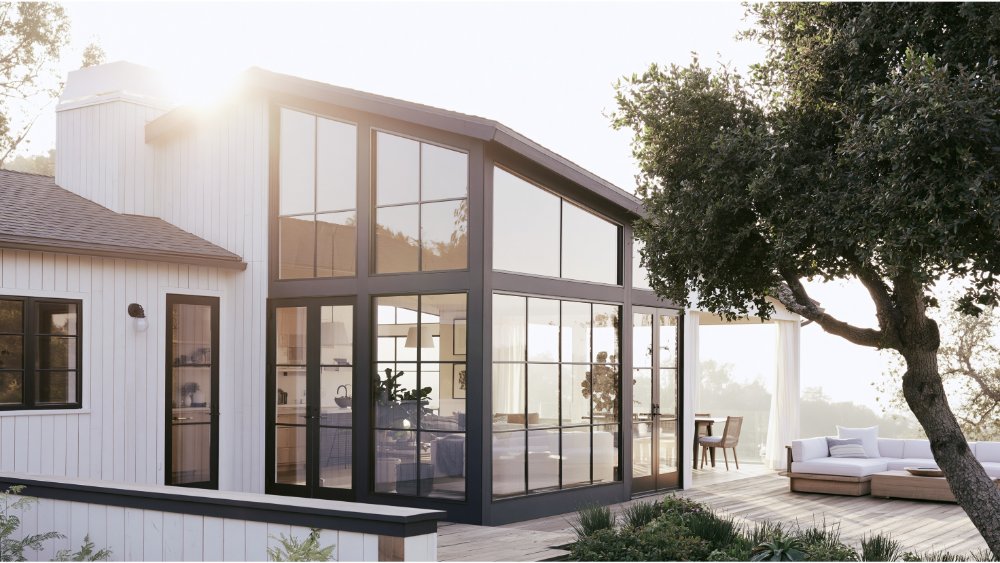
- Strong curb appeal. High contrast makes a façade look sharper and more finished, especially on homes wearing lighter colors like white, greige, or soft sand stucco. For many owners, that lift to the home’s curb appeal is the whole reason for the choice.
- The windows look bigger. A dark border defines the opening and makes the glass read as larger than the same window in white.
- Better views, less clutter. Black frames pull attention outward, and many homeowners find they need fewer heavy window treatments to make a room feel complete.
- They pair well with natural materials. Wood, stone, brick, and warm neutrals all sit comfortably next to black windows.
- Wide architectural range. Black suits a modern home naturally, and it works on farmhouse, industrial, and transitional designs when proportions and grille patterns are handled well.
- Low maintenance upkeep. Factory-applied finishes on vinyl never need painting or staining. Washing with mild soap and water is the whole routine, which is a real advantage over painted wood.
- Everything coordinates. Windows, sliding doors, entry doors, siding accents, and hardware can all speak the same design language, and when those design elements line up the result feels deliberate rather than trendy.
On property value, we’d rather be straight with you. Well-chosen new windows help a home show beautifully, and curb appeal matters to buyers. But no one can promise you a return on investment from a frame color.
The Cons of Black Windows Homeowners Should Know
- Heat absorption is higher. A dark color absorbs more solar energy than lighter colors do. That raises frame surface temperature and puts extra demand on the material, which is why lower-quality dark profiles can suffer thermal stress.
- Finish quality varies a lot. Lower-grade finishes can fade or chalk under heavy UV exposure. The warranty language is where you find out which one you’re buying.
- Dust and spotting show. Pollen, light-colored dust, and hard-water spray are more visible on dark profiles, and after a dry spell of road dirt black window frames ask for a rinse sooner than white ones do. (White shows dark grime more, so nobody wins outright.)
- Black can overwhelm a small or dim room. In a north-facing bedroom with limited natural light, heavy frames can close the space in rather than open it.
- It can fight a traditional façade. On some classic exteriors, black windows read as an add-on instead of an original feature.
- There’s usually a cost premium. How much depends entirely on the product line and finish method, so treat any blanket percentage you see online with suspicion.
- You can’t repaint your way out of it. Factory finishes on window frames are not interior walls. Choose carefully the first time.
Black Interior Windows and What They Do to a Room
Inside, the effect is stronger than most people expect. Black interior windows frame a view like artwork and make a bold statement against white walls, which is why interior design photography leans on them so heavily. They can also dominate. In a compact room with a warm, layered color palette, the same frames can feel heavy instead of crisp.
The usual fix is choosing black outside with a lighter frame inside where the product allows it, so your home’s interior keeps its lighter feel while the exterior still gets the contrast. Light colored walls, generous glass, and simple trim all help black work indoors. Ask early whether the line you’re considering offers matching or mismatched interior and exterior colors, because not every style does.
Do Black Windows Make a House Hotter? Heat Absorption and Energy Efficiency
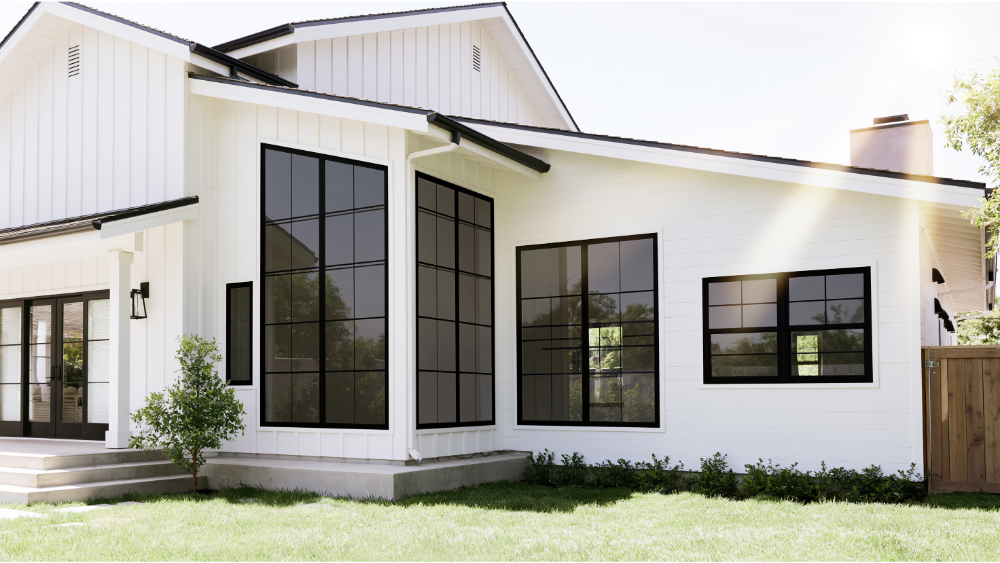
Two different things get blended together here, and separating them clears up most of the confusion.
Frame surface temperature is affected by color. Black absorbs heat from the sun more readily than lighter colors, so a sun-drenched dark frame will run hotter to the touch and can raise local temperatures right around the glass. That is real, and it is exactly what dark-finish engineering is built to manage.
Whole-window energy performance is a different measurement, taken on the finished unit. According to the U.S. Department of Energy, energy efficiency depends on window frame materials, number of panes, low-E coatings, gas fills, spacers, and how the window operates. Metal frames in particular need effective thermal breaks to control heat transfer. Color isn’t on that list.
Are Black Windows Energy Efficient? Read the Label, Not the Color
Black windows are as energy efficient as the unit they’re built into. The honest way to compare products is the NFRC label on the window itself:
- U-factor: how readily heat moves through the whole window. Lower is better.
- Solar heat gain coefficient (SHGC): how much solar heat gets in. Lower values mean the room takes on less heat.
- Visible transmittance: how much daylight comes through.
- Air leakage: how much air passes through the assembly.
ENERGY STAR® Version 7.0 took effect October 23, 2023, and requires NFRC-certified U-factor and SHGC values that meet the criteria for your climate zone. ENERGY STAR® reports that certified windows can cut heating and cooling costs by up to 13% nationwide compared with non-certified products. That performance belongs to the certified window, not to the color. A pair of black units and an identical pair in white will carry the same ratings when the glass package and frame are the same, and they will behave the same way on the wall. Judge the numbers, not the hue.
Black Vinyl, Capstock, Coatings, or Metal: How Black Windows Get Their Color
FGIA identifies heat buildup, weathering, and color retention as the core engineering challenges for dark vinyl windows. Capstock, laminates, coatings, and solar-reflective pigments all exist specifically to answer those challenges. Different materials and methods behave differently over time, so here’s how the main approaches compare:
| Method | How the color is created | What to ask about |
|---|---|---|
| Painted or coated finish | A factory-applied coating over the profile | Adhesion, chalking, and the written finish warranty period |
| Capstock (co-extrusion) | A colored layer bonded to the vinyl substrate during manufacturing | How the layer is bonded and which window styles it’s offered on |
| Laminate | A color film applied to the profile | Edge lift, heat performance, and exposure limits |
| Painted or anodized metal | Finish applied to aluminum or steel | Whether the frame has an effective thermal break |
Colored PVC profiles can be evaluated against AAMA 303, a voluntary specification covering dimensional stability, impact resistance, weatherability, heat resistance, heat buildup, and profile tolerances. Which gives you the single best question to bring to any consultation: How is the black color created on this specific profile, and what testing does it meet?
What Anlin Offers for Black Window Frames
As a factory-direct Anlin representative, we work with two routes to black. Designer Black™ is a capstock finish, where a black acrylic layer is molecularly bonded to the vinyl substrate through coextrusion, offered on select window styles and sliding patio doors. Architectural Black ThermaCoat™ is a solar-reflective exterior coating. Whether you can get black inside and out, or black outside with a lighter interior, depends on the product and frame option, which is exactly the kind of detail worth sorting out with samples in hand.
Do Black Windows Fade in the Sun? How Black Frames Hold Their Color
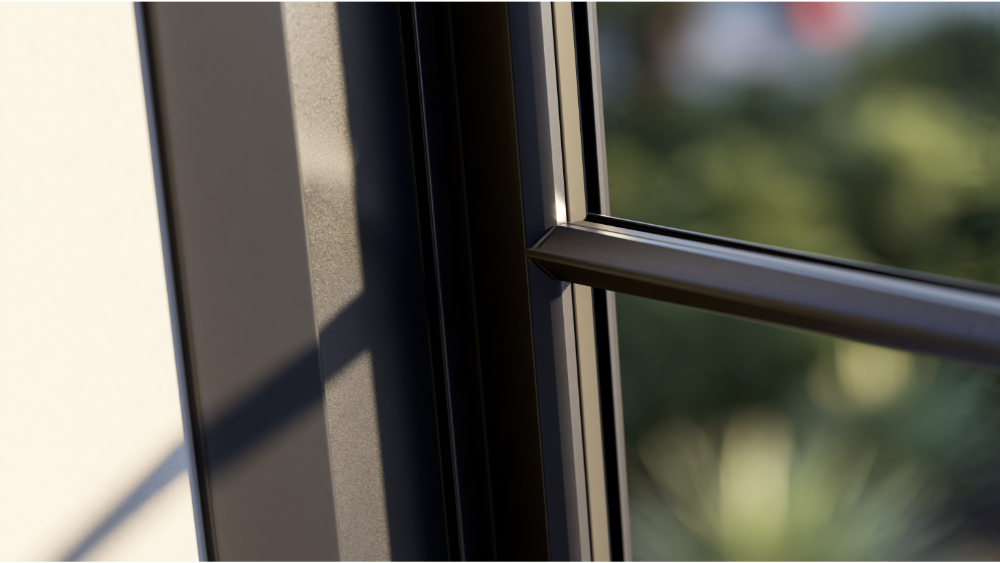
Some do. Fade resistant finishes largely don’t. The answer depends on how the color was made, how much direct sun that elevation takes, and how the finish is cared for.
A bonded capstock will resist fading differently than a surface coating, and a west-facing wall in a Sacramento July is a harsher test than a shaded north elevation. So ask for the written finish warranty, not a verbal reassurance, because that document is your best read on long term performance. Anlin’s current warranty documentation for products ordered from July 2024 onward lists a 15-year limited warranty on qualifying Designer Black capstock frames and a 12-year limited finish warranty on qualifying ThermaCoat exterior colors. Those finish periods are separate from Anlin’s Limited Double Lifetime Warranty on qualifying parts, glass, and accidental glass breakage, and separate again from our own 10-year labor warranty on installation. Three different coverages, and you deserve to see all three in writing.
For upkeep, Anlin recommends mild dish soap and water, and warns against abrasive, caustic, petroleum-based, or solvent cleaners.
Are Black Windows a Good Choice for Sacramento Homes?
They can be, with attention to sun exposure and the numbers on the label. West and south elevations here take intense afternoon sun for months, which is where finish technology and glass package selection earn their keep. That’s an argument for tested frames and a low-SHGC glass package, not an argument against black.
Sacramento sits in California Building Climate Zone 12, though the exact assignment should be confirmed by project address. California’s 2025 Energy Code took effect January 1, 2026 and applies to permit applications submitted on or after that date, including alterations. Under the current single-family prescriptive path in Climate Zone 12, replacement fenestration generally needs a maximum U-factor of 0.27 and maximum SHGC of 0.23, with an exception allowing up to 75 square feet of vertical replacement fenestration at 0.40 U-factor and 0.35 SHGC. Compliance method and scope affect which path applies, so treat these as planning figures.
Title 24 regulates energy performance, not color. Black replacement windows meet the same requirements as any other. The City of Sacramento also lists window replacement among projects requiring a building permit, so confirm permit requirements and current code figures with the local building department or your contractor for your specific address before ordering. A retrofit replacement in an existing opening is a different scope than a new opening cut into a wall, and the paperwork follows the scope. None of this changes because the frame is black. What it does mean is that your black windows need to arrive with an NFRC label carrying the right numbers for this climate zone, and that the installer handling your project should be treating permits and code compliance as part of the job rather than something you sort out afterward. Choose the product on its ratings and its written finish warranty, match the glass package to the elevation it’s going on, and black windows will look as good in year twelve as they do on install day.
Frequently Asked Questions
Are black windows going out of style?
No. Black has moved from a trend into an established frame color over roughly the last 15 years. A 2026 industry survey found 71% of participating experts named black a leading window frame color, ahead of white at 54%, while a 2025 consumer study of 1,108 respondents showed 45% would choose white and 14% black. White still holds the broader market, but black is a permanent, well-supported option rather than a passing look, and the Fenestration and Glazing Industry Alliance reports black vinyl windows have been produced for more than two decades.
Do black windows make a house hotter?
The frame gets hotter to the touch, but the room doesn’t. Dark colors absorb more solar energy, so a sun-drenched black frame runs warmer and can raise temperatures right around the glass, which is exactly what dark-finish engineering is built to manage. Whole-window energy performance is a separate measurement taken on the finished unit, and according to the U.S. Department of Energy it depends on frame material, number of panes, low-E coatings, gas fills, spacers, and operation type. Color isn’t a factor in the rating. Identical black and white units with the same glass package carry the same NFRC numbers and perform the same on the wall.
Do black window frames fade in the sun?
Some do, and some don’t. It depends entirely on how the color was created, how much direct sun that elevation takes, and how the finish is maintained. A bonded capstock layer resists fading differently than a surface coating, and a west-facing wall in a Sacramento July is a much harder test than a shaded north elevation. Ask for the written finish warranty rather than a verbal assurance, since that document tells you what the manufacturer will actually stand behind. For upkeep, mild dish soap and water is the recommended routine, and abrasive, caustic, petroleum-based, and solvent cleaners should be avoided.