Key Takeaway
A window is made up of four core systems: the frame (head, jambs, and sill) that anchors the unit to the wall, the sash that holds the glass, the glazing package (panes, spacer, gas fill, and coatings), and the hardware, seals, and drainage that keep it operating and weathertight. Knowing the parts of a window helps you pinpoint problems, read replacement quotes accurately, and communicate clearly with contractors.
A residential window is built from four systems working together. The window frame is the fixed outer structure (head, side jambs, and sill) that anchors the unit to your wall. The window sash is the framework holding the glass, made up of vertical stiles and horizontal rails. The glazing package includes the glass panes, spacer, gas fill, and coatings. And the hardware, seals, and drainage keep the window operating, sealed, and shedding water.
Maybe you’re trying to name a broken window part, decode the window terminology on a replacement quote, or figure out where that draft is coming from. Below you’ll find plain-English definitions of the basic parts, what each window component actually does, and what it looks like when it stops working.
What are the main parts of a window? Key components at a glance
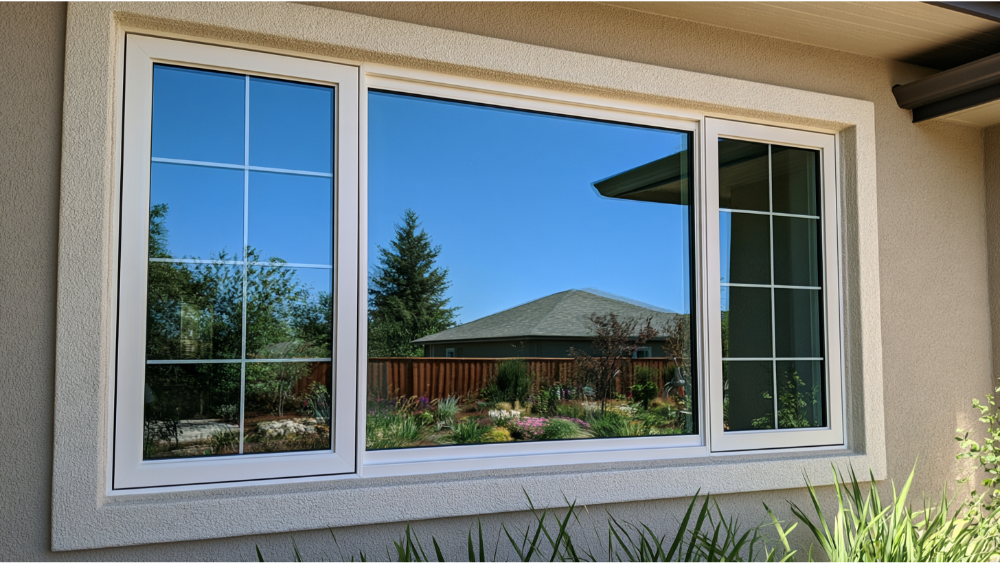
Every window, no matter the style, can be sorted into five functional groups. Once you know which group a window part belongs to, conversations with a contractor get a lot easier.
| Functional group | Where it is | What it does |
|---|---|---|
| Window frame | The fixed outer perimeter | Anchors the window to the wall and holds the assembly together |
| Window sash | Inside the frame | Holds the glass and allows the window to open (or stays fixed) |
| Glass / glazing package | Within the sash | Lets in light while controlling heat transfer |
| Hardware | On the sash and jambs | Sash locks, lifts, cranks, and balances that secure and operate the window |
| Seals and drainage | Between sash and frame, and at the sill | Blocks drafts and dust, and drains incidental water outside |
A labeled diagram belongs here: an interior view, an exterior view, and a cross-section through the sill.
The four layers around every window (and why the difference matters)
Most online guides lump everything near a window into one list. That’s where confusion starts. Here’s the cleaner way to think about it:
- The manufactured window unit: window frame, sash, and glass panes, built in a factory as one assembly.
- Hardware, seals, and drainage: sash locks, balances, operators, weatherstripping, and weep holes.
- Installation and weatherproofing materials: flashing, sill pan, shims, backer rod, sealant, perimeter insulation.
- Trim and wall framing: casing, stool, apron, jamb extension, header or lintel, and the rough opening itself.
Why it matters: when a window replacement quote says “frame,” it might mean the window’s own frame or the wall opening around it. Knowing which layer someone is talking about keeps the conversation and the scope of work clear.
What are the basic parts of a window frame?
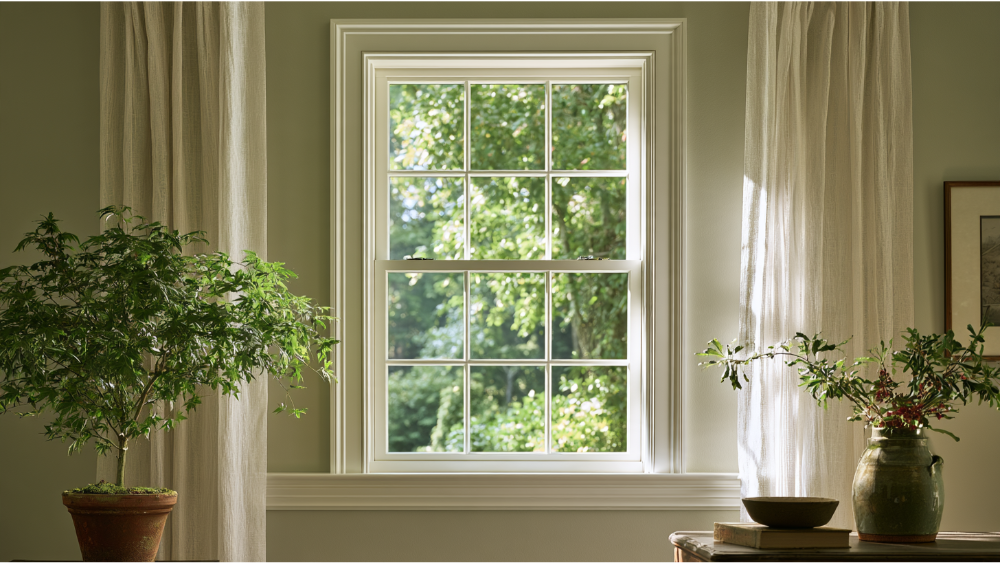
The window frame is the fixed outer structure that holds the entire assembly together and ties it into the wall. It doesn’t move. Every other window component hangs off it.
- Head: the top horizontal member of the window frame.
- Side jambs: the vertical sides that form the inner edges of the opening.
- Sill: the bottom horizontal member, sloped on the exterior to shed water away from the house. When someone says window sill, this is usually the piece they mean.
- Jamb liner: the channel a hung sash rides in, often housing the balance system.
- Nailing fin or mounting flange: a flat lip used on new-construction units to fasten the window to the wall sheathing. It’s hidden once siding and trim go on.
One clarification worth making: the head is part of the window. The header or lintel above it is wall framing, and that’s the piece providing structural support over the opening.
What are the essential parts of a window sash?
The window sash is the framework that holds the panes of glass. A common mistake is defining it as “the part that moves.” Sashes can be operable or fixed, and plenty of picture windows have a stationary sash or glass set directly into the window frame.
- Stiles: the vertical components of the sash.
- Rails: the horizontal members of the sash.
- Meeting rail (or check rail): the horizontal section where the top and bottom sashes come together on a hung window. It’s usually where the sash lock lives.
- Glazing bead: the strip that secures the glass into the sash.
A close-up window sash diagram helps here, so rails and stiles don’t get confused with the head and jambs of the main frame.
Window glass: panes of glass, insulated glass units, and triple pane glass
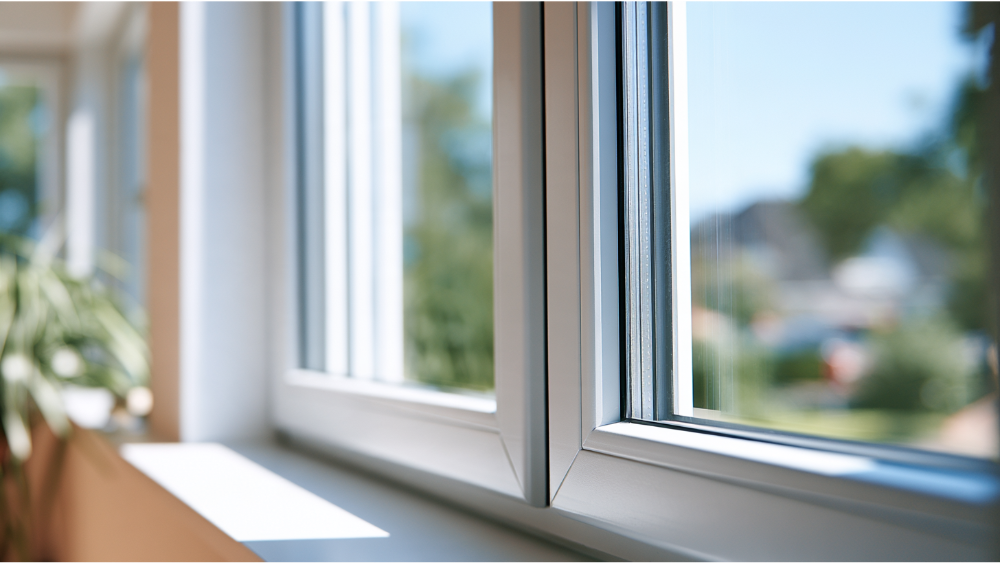
A pane (also called a lite) is a single sheet of glass. Glazing refers to the glass assembly as a whole. Single pane glass is rare in modern windows because it offers minimal insulation and does so little to slow heat transfer. Most modern windows use multiple panes of glass sealed into one insulated unit.
The Department of Energy notes that argon commonly performs well in a glazing space of roughly half an inch, while krypton is often used in narrower spaces of about a quarter inch. Treat those as design examples from DOE, not measurements for ordering replacement glass. Actual unit design is product-specific.
What is an insulated glass unit (IGU)?
An IGU is two or three glass panes held apart by a spacer bar and sealed around the perimeter, creating an insulating cavity filled with air or argon gas. Low E coatings are factory applied to the glass to reflect infrared and ultraviolet light, and they help reduce heat transfer more than almost any other part of the package. When a window fogs between the panes of glass, the edge seal has failed.
Double pane vs. triple pane glass
Dual-pane glass puts two layers of glass around a sealed cavity and insulates far better than single pane. Triple pane adds another cavity, which can improve insulation and noise control, but it also adds weight and depends heavily on the specific product. The right choice varies by climate zone and by what you’re trying to fix. Paired with the right coatings, a well-built dual-pane unit already delivers excellent insulation for most homes, and that combination usually does more for energy efficiency than adding glass panes alone.
You’ll also hear about muntins, the bars that divide a larger glass area into smaller glass panes. Modern versions are usually grilles between the glass or simulated divided lites applied to the surface. More on that terminology below.
Window hardware: sash locks, balances, and operators
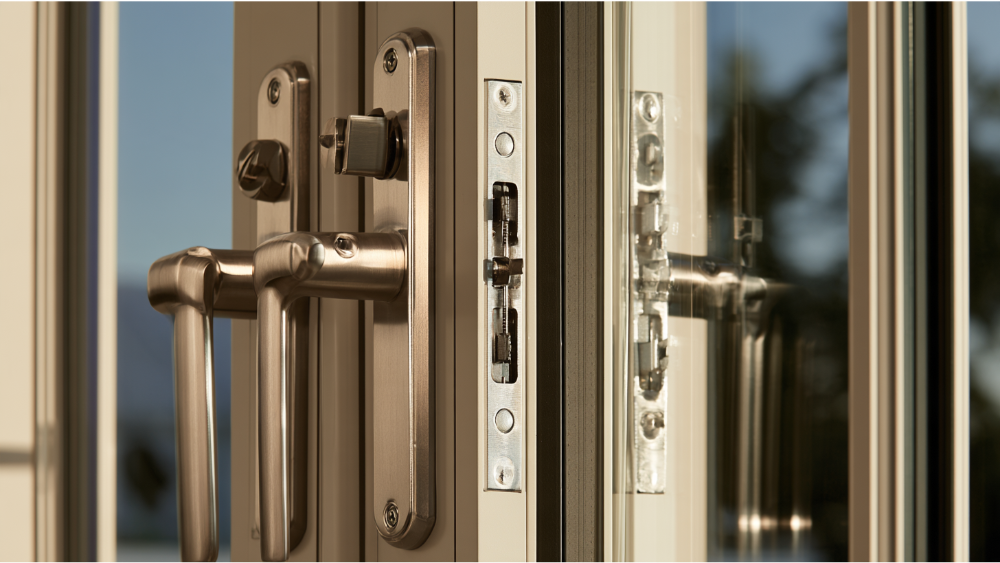
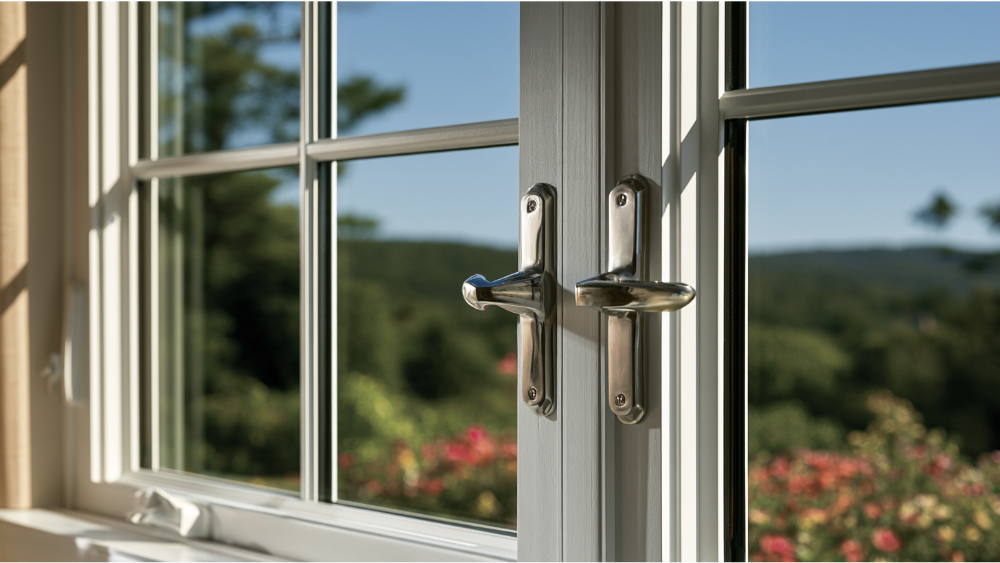
Hardware is what makes a window secure and pleasant to use. Quality hardware shows up as smooth operation and sash movement that stays effortless for years. When these window parts fail, you notice immediately.
- Sash lock and keeper: cam locks pull the sashes tight together, which also stops rattling.
- Lift or handle: the grip you use to raise or pull the sash.
- Balance system: the spring or coil mechanism that holds a hung sash at whatever height you leave it.
- Tilt latches: release the sash inward for easy cleaning of the exterior glass from inside.
- Hinges: carry the swinging sash on casement windows and awning windows.
- Crank operator: the geared mechanism that lets a casement or awning sash swing open.
- Rollers and track: let a slider’s sash glide horizontally.
- Screen: keeps insects out when the window is open.
One correction worth noting: a fixed picture window may have no operating hardware or sash locks at all. That’s by design, not a missing part.
Weatherstripping, weep holes, and the seals you never see
Weatherstripping seals the gap between the sash and the frame when the window is closed. Made from foam, rubber, or felt depending on the product, it blocks drafts, dust, and moisture, and it does real work for your energy bills. Compression gaskets on casement windows and awning windows tighten as the sash closes, which is part of why fully locking a sash matters. Locking compresses the seal the way the manufacturer designed it to, and a compressed seal is a big piece of real-world energy efficiency.
Weep holes are the small openings along the exterior sill that let condensation or wind-driven rain drain back outside. Never caulk or seal weep holes shut. They are drainage, not a manufacturing defect, and blocking them traps water exactly where you don’t want it.
Interior trim, casing, and decorative elements around the window
These pieces surround the window but usually aren’t part of the manufactured unit:
- Stool: the interior ledge most people call the “inside sill.”
- Apron: the trim piece directly beneath the stool.
- Casing: the trim framing the window on the interior or exterior.
- Brickmould: exterior trim that covers the gap between the frame and the wall surface.
- Jamb extension: fills the gap between the window frame and a thicker wall.
- Mullion: a vertical or horizontal member joining two or more windows into one combination unit.
Behind the trim sits the layer nobody ever sees: flashing, sill pan, shims, backer rod, sealant, and perimeter insulation. These control water and air at the window-to-wall connection. Done well, they’re invisible forever. Done poorly, they show up years later as stained drywall.
Commonly confused window terms
| Term pair | The difference |
|---|---|
| Frame vs. sash | The window frame is the fixed outer structure; the window sash is the inner framework holding the glass. |
| Sill vs. stool vs. apron | The sill is the bottom member of the window frame, the stool is the interior ledge, and the apron is the trim below the stool. |
| Muntin vs. mullion vs. grille | A muntin divides a sash into individual panes, a mullion joins separate window units, and a grille or grid is a decorative bar that mimics muntins. |
| Pane vs. lite vs. glazing | Pane and lite both mean a single sheet of glass; glazing refers to the glass assembly overall. |
| Head vs. header/lintel | The head is the top of the window frame; the header or lintel is wall framing that carries the load above. |
Frame, sash, rail, and stile terminology follows National Park Service Preservation Brief 9; the muntin and mullion distinction follows the NYC Landmarks glossary.
How do window parts differ by window type?
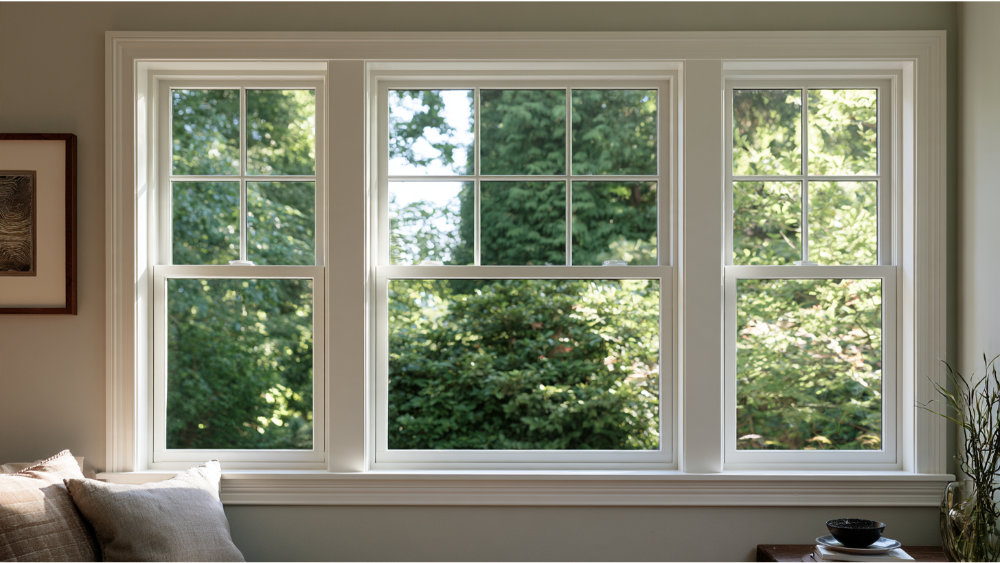
The window frame and glazing stay broadly similar across styles. Hardware is where the real differences show up.
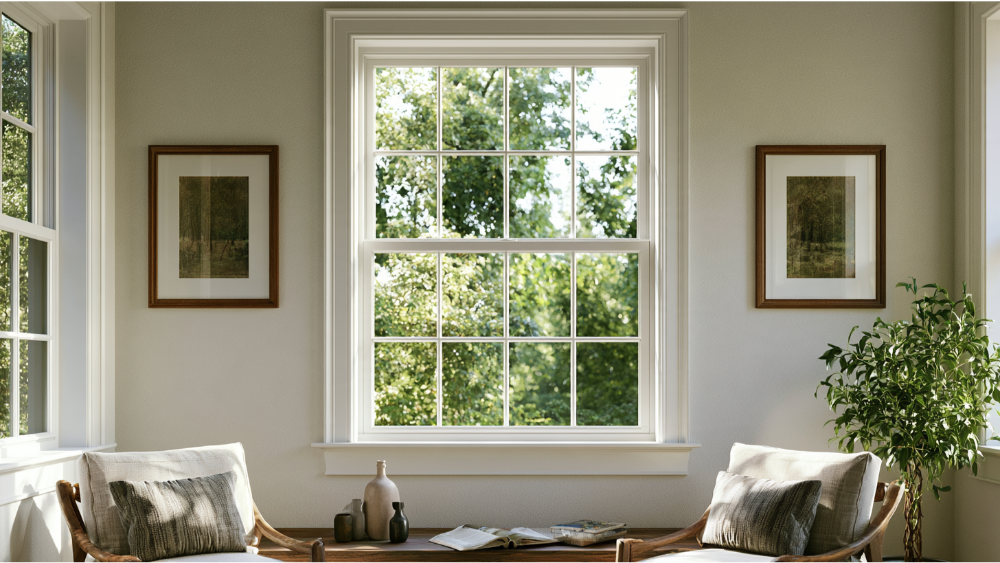
Single hung windows and double hung windows (one or two movable sashes)
Single hung windows have one operable bottom sash and a fixed top sash. A double hung window has two movable sashes plus tilt latches for easy cleaning. Both rely on a balance system and a check rail where the two sashes meet. On a second-story bedroom, a double hung lets you wash both panes of glass without ever stepping outside.
Sliding windows
Sashes glide horizontally on rollers in a track, with weep drainage at the sill. The wide, low profile suits a modern aesthetic with clean lines. Fewer moving window components generally means low maintenance, and the sashes often lift out for easy cleaning.
Casement windows and awning windows
On casement windows, a crank operator swings the sash open on hinges. The compression seal tightens as the sash closes against the frame, which is why casement windows tend to post strong air-sealing numbers and give you precise control over how much fresh air comes in. Awning units work the same way, hinged at the top so they shed light rain.
Fixed and picture windows
Built for maximum natural light and an unobstructed view, with no operating hardware. The glass may sit in a fixed sash or be set directly into the frame. Bay, bow, geometric, and garden windows are variations assembled from these same key components.
Which window parts affect energy efficiency the most?
Here’s what most articles get wrong: energy performance is a whole-window property, not a glass property. The NFRC rates the complete unit including the glazing, window frame, sash, and spacer, not just glass at the center of the pane.
Window frame materials and energy efficiency
Frame material matters. Wood insulates naturally and brings a timeless beauty to traditional homes. Vinyl windows are affordable, resist moisture, won’t rot, and need little upkeep. Fiberglass is strong and performs well thermally. Aluminum is lightweight but conducts heat readily, making it the weakest insulator of the group and the toughest material to make energy efficient without a thermal break.
On the NFRC label, U-factor measures heat transfer (roughly 0.20 to 1.20 for residential windows, lower is better). SHGC and visible transmittance both run on a 0 to 1 scale, covering solar heat admitted and daylight admitted. Air leakage measures air passing through the product.
ENERGY STAR® Version 7.0 took effect October 23, 2023. It caps U-factor at 0.22, 0.25, 0.28, and 0.32 for the Northern, North-Central, South-Central, and Southern zones, with an air-leakage limit of 0.3 cfm/ft². ENERGY STAR estimates certified products can lower household energy bills by a national average of 13% compared with non-certified products. That’s a national average estimate, not a guaranteed result for your house.
Why installation matters as much as the window itself
NFRC ratings don’t account for installation quality. ENERGY STAR Version 7.0 requires manufacturer instructions covering flashing, shimming the unit level, plumb and flush, and sealing at the product-wall interface. An energy efficient window installed carelessly won’t deliver what the label promises. Precision at the opening is what turns a good product into lasting performance, and it’s where most of the real-world energy efficiency is won or lost.
Match the symptom to the window part
| Symptom | Likely part | Commonly serviceable? |
|---|---|---|
| Sash falls shut on its own | Balance system | Often, with matching parts |
| Fog or haze between the glass panes | IGU edge seal failure | IGU replacement, not a repair |
| Draft around the sash perimeter | Weatherstripping, alignment, or sash lock | Often |
| Crank turns but the sash won’t move | Operator | Often, product-specific |
| Slider sticks or drags | Rollers or debris in the track | Usually |
| Water pooling at the sill | Blocked weep holes, flashing, or sealant | Needs diagnosis |
| Peeling paint or soft trim | Moisture intrusion behind the trim | Needs diagnosis |
One distinction worth keeping straight: water on the interior glass surface is usually indoor humidity condensing on cold glass. Moisture trapped between the panes of glass means the seal has failed.
Can one window part be repaired, or do you need window replacement?
It depends on which layer failed. A useful way to sort it:
- Often serviceable: screens, sash locks, tilt latches, rollers, and weatherstripping.
- Product-specific, may require matching the manufacturer: sashes, balances, crank operators, and insulated glass units.
- Points toward window replacement or an installation evaluation: a rotted or damaged frame, recurring water intrusion, several failed window components in one unit, or comfort problems showing up across many windows at once.
When several of those issues stack up in the same house, new windows usually solve more than a long string of individual repairs.
Two safety notes. For paid work in pre-1978 housing, the EPA’s Renovation, Repair and Painting Rule generally applies to window replacement when painted surfaces are disturbed, regardless of the usual minor-repair thresholds of 6 square feet interior and 20 square feet exterior. And if you’re changing a bedroom or basement egress window, the 2024 IBC sets model benchmarks (5.7 ft² net clear opening, 5.0 ft² at grade floor, 20 inches clear width, 24 inches clear height, and a maximum sill height of 44 inches). Adopted requirements vary by jurisdiction, so confirm locally first.
Frequently asked questions
What are the parts to a window called?
The main parts are the window frame (head, side jambs, sill), the window sash (stiles, rails, meeting rail), the glass or glazing package, and the hardware, seals, and drainage components that let the window operate and stay weathertight.
What are the 5 parts of a window and their functions?
The frame anchors the unit to the wall. The sash holds the glass. The glazing package controls light and heat transfer. Hardware secures and operates the window. Seals and drainage block drafts and move water back outside.
What is the difference between a window frame and a window sash?
The frame is the fixed outer structure attached to your wall and it never moves. The sash sits inside the frame and holds the glass. A sash may slide, swing, or stay permanently fixed depending on the window style.
What are weep holes, and should they be cleaned?
Weep holes are small openings along the exterior sill that drain condensation and incidental rainwater outside. They should be kept clear of dirt and debris. Never caulk them shut, since sealing them traps water inside the frame.
Let’s get your window project started
Drafts, fogging, and water at the sill often involve more than one window component, which is why a hands-on look beats guesswork. If you’d like a starting point with no commitment, try our online window cost estimator, or book a free consultation and we’ll walk the house with you to see whether a repair or full window replacement makes more sense. Prefer to talk it through? Call us at (916) 202-2282.