
Key Takeaway
Window trim is the finished material surrounding a window that covers the gap between the window frame and the wall, adding style while protecting exposed edges. It includes casing, stool, apron, and exterior brick mould. Trim alone does not air-seal or waterproof an opening; flashing and sealed rough openings behind the trim do that work. Recurring damage at the same spot almost always points to a moisture or installation issue, not the trim itself.
Window trim is the finished material surrounding a window inside and outside your home. It covers the transition between the window frame and the wall, adds character to the opening, and protects vulnerable edges from weather. Before you pick a style or chase a draft, sort out one thing: is your question cosmetic, or something deeper? Trim gives an opening its finished look, but the air sealing and flashing behind it are what actually control air and water. Getting that straight early can save you from paying twice for the same repair.
What Is Window Trim, and What Does It Actually Do?
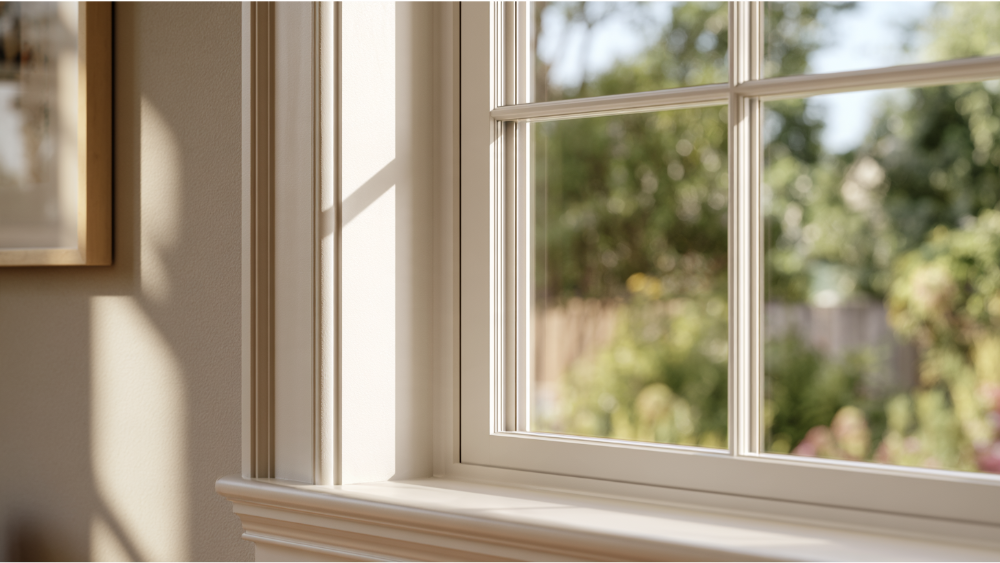
When a window is installed, there’s a space between the window unit and the rough opening framed into the wall. Trim covers that space and gives the opening a clean, intentional edge. It also sets a room’s design tone and shields exposed material at the perimeter.
What trim does well:
- Covers the rough-opening transition between window, jamb, and wall
- Defines the architectural character of a room or facade
- Protects exposed edges and limits dust and air movement into the wall cavity
What trim does not do on its own: it is not the air seal, it is not flashing, and it is not waterproofing. Trim is the visible edge of a larger installation system.
Window Trim vs. Window Casings vs. Window Frame vs. Window Sill
The words “trim,” “casing,” and “molding” get swapped around constantly, even in the trades. Here’s how we use them.
| Term | Where it is | Main role |
|---|---|---|
| Window frame | Part of the window unit | Supports the sash and glass |
| Jamb | Sides and head of the opening | Forms the finished opening |
| Casing | Visible boards around the opening | Covers the transition, adds style |
| Trim | The broader finish category | Includes casing plus added detail |
| Stool (interior “sill”) | Interior bottom ledge | Finishes the lower opening |
| Exterior sill | Exterior lower surface | Directs water away from the wall |
| Apron | Below the stool | Decorative finish |
| Brick mould / exterior casing | Outside perimeter | Finishes the window-to-siding transition |
Most homeowners call the interior ledge a window sill, and the board that forms it is sold as a window sill board. In the trades that piece is the stool, and the true sill is the sloped exterior surface that sheds water away from the wall.
How Interior Window Trim Differs From Exterior Window Trim

Interior trim
Inside, trim is mostly about design. It hides the joint where jamb, wall, and window meet and ties the window into the room’s millwork. Paint or stain drives material choice. MDF and finger-jointed wood work well for paint-grade work in dry spaces. Solid wood is the choice when you want visible grain, though raw wood should be sealed on all faces before it goes up. In bathrooms and laundry rooms, PVC or composite handles humidity and moisture issues better.
Exterior trim
Outside, trim carries the curb appeal and manages the transition to siding or stucco while taking sun, heat, rain, and pests year-round. Preservative-treated wood, cellular PVC, composite, fiber cement, and aluminum capping are the usual candidates. Two rules never bend out here: exterior trim is attached over flashing, not instead of it, and it must never block the drainage weeps that let water escape the window.
Common Window Trim Styles and Ideas (and How Wide They Usually Are)
Most trim falls into a handful of recognizable style families. None is objectively better. What matters is whether the profile suits your home’s architecture.
- Modern: Flat, square profiles with clean lines and no visible ornamentation.
- Ranch: Low-profile casing about 2.5 to 3 inches wide, understated and simple.
- Provincial: Gently profiled boards, 2.5 to 3.5 inches.
- Craftsman: Wide flat boards, square-cut joints, a substantial head casing, often with a stool and apron.
- Colonial: Profiled casing roughly 3 to 6 inches wide, often layered with mitered corners, where the two pieces at each joint need matching 45-degree cuts.
- Victorian: Highly decorative, with rosettes at the corners, fluted legs, and layered profiles.
- Farmhouse or cottage: Wide flat boards, simple proportions.
Trim thickness generally runs from about a half inch to a full inch deep. Proportion is where most trim ideas go wrong. Scale the width to your ceiling height, the window size, and the room: wide or ornate boards give a small window real presence in larger spaces, but the same casing in a low-ceilinged room reads heavy. Nothing fancy is required, and in a new house builders often default to narrow flat casing that’s easy to upgrade later.
What Is the Best Material for Window Trim?
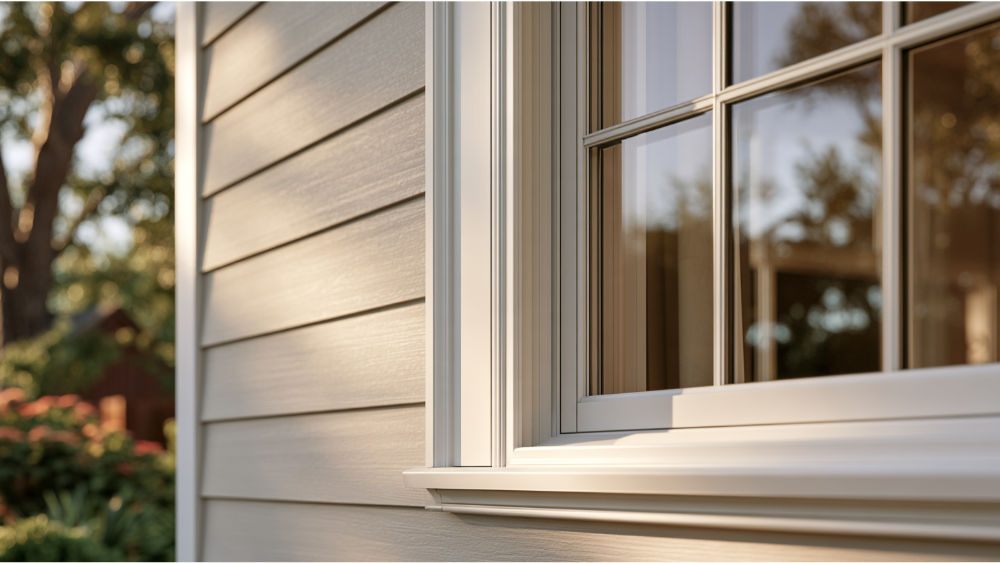
The right material depends on exposure more than taste. A board that performs beautifully in a dry living room can fail on a west-facing wall, so spending more up front often avoids a full replacement later. As you shop, check what the manufacturer allows for exterior use.
| Material | Best suited to | Advantages | Watch for |
|---|---|---|---|
| Solid wood | Stain-grade interiors, traditional detail | Natural grain, repairable | Moisture and ongoing maintenance |
| MDF | Painted dry interiors | Smooth, consistent painted finish | Poor performance with repeated moisture |
| PVC / composite | Moisture-prone interiors, approved exterior uses | Rot resistance, low maintenance | Thermal expansion, product-specific fastening |
| Vinyl | Low-maintenance applications | Moisture resistance | Limited profile options |
| Fiber cement | Exterior trim integrated with siding | Durability, moisture and pest resistance | Correct cutting, clearances, flashing |
| Aluminum capping | Exterior protection, modern detailing | Low maintenance | Dents, quality of the detail work |
James Hardie trim is one fiber-cement option often used alongside James Hardie siding for window accents, with a 30-year non-prorated limited transferable substrate warranty on qualifying products. Confirm the current written warranty terms before you specify it.
Painted or Stained Trim: A Finished Look That Matches Door Trim, Baseboards, and Crown Molding
Painted trim gives you a clean, uniform look and can brighten a room considerably. White casing stays popular for exactly that reason. Stained wood goes the other direction, showing the grain and adding warmth that suits traditional and Craftsman interiors.
On coordination, a few rules of thumb:
- Keep the finish consistent within a room or floor for a cohesive look
- Profiles on your window casings, door trim, and crown molding don’t have to match exactly, as long as the scale feels deliberate
- Bold or dark trim works as a focal point when it’s a real design decision, not an afterthought
- Outside, contrasting trim frames the openings against the siding
Is the Problem Really the Trim?

This is where most homeowners lose money. On trim that keeps failing, new caulk and fresh paint treat the symptom, not the cause. Use this table to tell which problem you have.
| Symptom | Likely cause | Next step |
|---|---|---|
| Small surface crack | Finish movement | Fill and refinish if the material is sound |
| Loose casing | Failed fastening | Refasten after checking wall condition |
| Draft at the trim edge | Unsealed rough opening | Inspect and air-seal behind the trim |
| Peeling paint that returns | Moisture or poor prep | Find the moisture source before repainting |
| Soft or crumbling exterior wood | Rot | Remove the damaged material and inspect flashing |
| Stain below the window sill | Drainage or flashing failure | Professional moisture inspection |
| Window binds or won’t lock | Frame distortion or installation issue | Inspect the window, not just the trim |
| Caulk that keeps cracking | Movement or wrong joint design | Correct the underlying detail |
Damage that keeps coming back in the same spot is almost never a trim problem.
What Should Be Happening Behind the Trim
The U.S. Department of Energy recommends air-sealing the rough opening before the trim goes on. In DOE-cited testing, a window with a 3/4-inch rough-opening gap measured an equivalent leakage area of 28.2 cm²/m²; sealing the interior side dropped it to 0.5 cm²/m². No amount of beautiful casing closes that difference.
A proper installation handles all of this:
- A sealed rough opening, with sealant matched to the gap. ENERGY STAR® suggests caulk for gaps of roughly 1/4 inch or less and low-expansion window-and-door foam for larger ones
- Restrained use of foam, since over-expansion can bow the frame and interfere with operation
- Head, jamb, and sill flashing integrated with the wall’s drainage plane
- Drainage weeps left completely unobstructed
- Even reveals and a window that operates smoothly before any trim goes back on
That sequence is the key difference between trim that looks good on day one and an opening that performs for decades.
Do You Need New Trim When You Install a New Window?

Not always. Existing trim can often be saved, and whether it is depends on:
- The installation method (retrofit versus full-frame replacement)
- The condition of the current casing
- Any change in frame depth or dimension
- Old paint lines and wall damage that would show once the new unit is in
- Whether the opening needs to be exposed for air sealing or repair
- Whether exterior capping, siding, or stucco work is part of the job
Whatever the answer is for your home, it belongs in writing on the estimate. Most of our window and door installations wrap up in one to two days, including cleanup and a final walkthrough, and we’d rather you know the trim plan before we start than discover it mid-project.
Is DIY Window Trim an Easy Way to Refresh a Room?
Swapping interior casing in a dry room is a fair weekend project if you’re handy and own the tools: miter saw, nail gun, level, tape measure, caulk gun. Work in order. Pry the old trim off carefully so you can save it as a template, air-seal the gaps behind it, then cut each piece to length. Set up on a workbench or table so your cuts stay square, and cut the two side legs to the same length so the top piece sits level. Hold the casing back slightly from the inside edge of the jamb for an even reveal. Two-inch finish nails driven into the studs and jamb hold well, and a 1×6 makes a workable window sill board in a standard 2×4 wall. Fill the nail holes, sand them smooth, caulk the joints, prime raw wood, and plan on two coats of paint.
Stop and call a professional the moment you find rot, recurring water stains, or work that requires disturbing siding or stucco. And if your home was built before 1978, EPA’s Renovation, Repair and Painting Rule applies to paid work disturbing more than 6 square feet of painted surface per room indoors or 20 square feet outdoors. Full window replacement is covered regardless of square footage.
Northern California Window Trim and Replacement Considerations

Sacramento-area summers punish exterior materials. Sustained heat and UV exposure fade finishes and stress wood, which is why fiber cement and cellular PVC hold up well here. Seasonal rain makes drainage detailing matter, and matching existing stucco or siding takes planning. In fire-hazard areas, noncombustible exterior materials may be worth a closer look.
On code: Title 24 energy requirements apply to the window being replaced, not to decorative trim. Sacramento lists window replacements among permit-required projects, and the 2025 California Building Standards Code took effect January 1, 2026. Sacramento sits in Climate Zone 12. We work within these standards daily, and we’d still confirm specifics with your city or county building department.
What to Ask for in a Window or Trim Estimate
- Are the existing window casings being saved, removed, or replaced?
- Which interior and exterior materials are specified?
- Are paint, stain, caulk, drywall, siding, or stucco repairs included?
- How will the rough opening be air-sealed?
- How is water directed out of the opening?
- Who pulls the permits?
- What manufacturer warranty applies, and what labor warranty?
- Is cleanup and a final walkthrough included?
California requires a written home-improvement contract on projects over $500, with the down payment capped at $1,000 or 10% of the contract price, whichever is less. Warranties deserve the same clarity. The Anlin Limited Double Lifetime Warranty is manufacturer coverage on the window itself, including vinyl, insulated glass, hardware, and accidental glass breakage. Our 10-year labor warranty on installation is separate. Trim materials carry their own manufacturer coverage.
Frequently Asked Questions
What is the trim around a window called?
Casing is the standard term for the boards immediately around the opening. Trim is the broader category, covering casing plus features like the stool, apron, backband, and header.
What is the difference between window trim and molding?
Trim is the general category of finish material around an opening. Molding refers to the shaped profiles used within it. Casing is the trim installed around a window.
What type of trim is best for windows?
It depends on exposure. MDF or wood suits dry interiors, PVC or composite suits bathrooms and other damp rooms, and fiber cement or preservative-treated wood belongs outside.
What are the current window trim trends?
White painted casing stays popular, along with wide flat boards in Craftsman and farmhouse styles. Stained wood adds warmth, and dark trim shows up as a deliberate focal point.
Let’s Get Your Project Started
Trim finishes the look. What’s behind it protects your home. If you’re seeing drafts, stains, or tired window casings, we’ll assess the trim and the opening together during a free, no-obligation estimate on windows, doors, or siding. 0% APR financing is available OAC, with terms reviewed at your consultation. Prefer to start online? Try our window cost estimator, or call us at (916) 202-2282.